

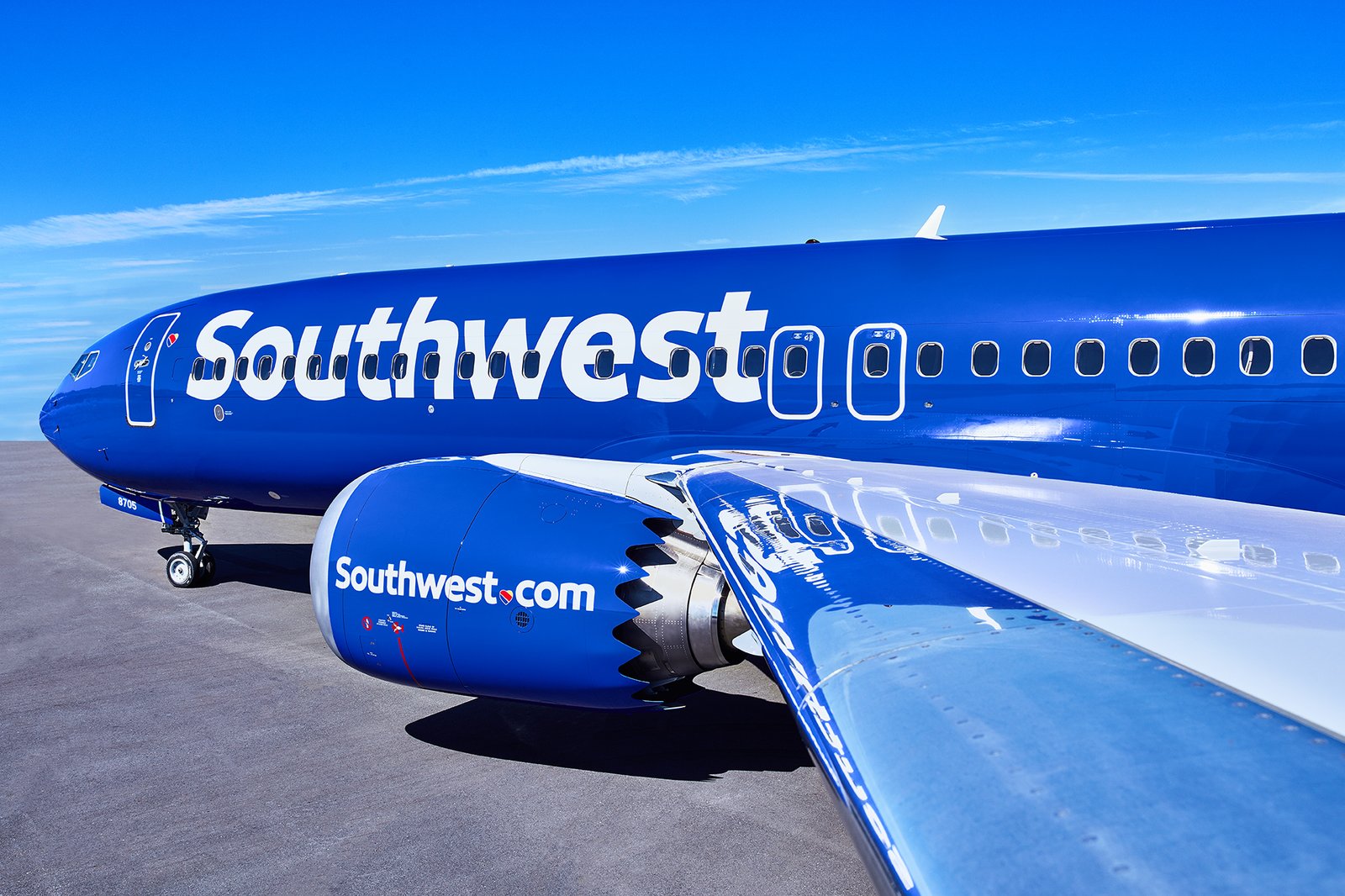
Record Q1 revenues and a sharp 8-point margin swing mark a decisive operational reset. Now, Q2’s looming $4.10–$4.15/gallon fuel costs will put Southwest’s transformation under severe pressure.
VoyageWire Intelligence |April 25, 2026
AT A GLANCE
- Q1 2026 revenues set a record at $7.2B, up 12.8% year-over-year.
- Operating margin up 8.1 points YoY to 4.6%; adjusted net margin likely leads peers.
- ~60% of customers upgraded from the base product in Q1 2026, up from ~20% in 2025. Assigned seating is working
- Managed business revenue up 16% in Q1 and 25% in March; both are company records.
- Q1 fuel at $2.73/gallon outperformed estimates, but Q2 guidance vaults to $4.10–$4.15/gallon, emerging as Southwest’s critical swing risk. This spike threatens the advances achieved.
- Full-year EPS target of $4.00 maintained but explicitly contingent on lower fuel and/or stronger revenues.
- Starlink Wi-Fi deployment begins summer 2026; ANA partnership adds seventh global carrier alliance.
- Chicago O’Hare and Washington Dulles services suspended in June; capacity reallocated to higher-return markets.
The Turnaround Is Real, But Fuel Is the Wildcard
Southwest Airlines entered 2026 with momentum rebuilt over two years. Q1 results confirmed that the commercial transformation announced 18 months ago has moved from promise to measurable results. Operating revenues of $7.2 billion marked a first-quarter record. Operating margin expanded 8.1 points year-over-year to 4.6%. Net income came in at $227 million, or $0.45 diluted EPS, in line with guidance.
Operating cash flow hit $1.4 billion, up 65% from Q1 2025. On nearly every financial metric that matters to investors, Q1 delivered. The number defining Q2 and possibly the full year is the escalating fuel cost. It jumped to $2.73 per gallon in Q1, $0.33 above guidance, pounding earnings with a $164 million headwind.
But Q2 guidance is more dire: $4.10–$4.15 per gallon, marking a structural shift that must be urgently absorbed by Southwest’s revenue engine.
CEO Bob Jordan called the external environment ‘uncertain’ yet projected confidence in Southwest’s defensive positioning. The urgency is clear: the revenue trajectory must battle intense fuel spikes. Q2 RASM is guided at +16.5 %- +18.5 % YoY, but a wide Q2 EPS range ($0.35–$0.65) signals deep concern; management knows the fuel math is unresolved and decisive.
Assigned Seating Pays Off Faster Than Expected
The most structurally significant data point in the Q1 report is the customer upgrade rate. Approximately 60% of Southwest customers upgraded from the base product in Q1 2026, compared to roughly 20% in 2025. That is a threefold increase in a single year, following the January 27 launch of assigned and extra-legroom seating.
Southwest’s legacy open seating model was a point of competitive differentiation for decades and a source of persistent friction for business and premium leisure travellers. The decision to abandon it was not without internal resistance. The Q1 data suggests the calculus was correct: customers, when given the option to pay for comfort and certainty, are taking it at a rate that exceeds the company’s publicly projected rate.
Rapid Rewards engagement reinforces the story. Enrollments grew 37% year-over-year; tier-status earners increased 62%. Loyalty programs are typically lagging indicators of brand perception. When both enrollment and high-value tier attainment are growing simultaneously, it reflects genuine demand recovery, not promotional distortion.
Fleet upgrades advance: two-thirds of aircraft will have in-seat power and larger bins by late 2026. Starlink Wi-Fi deployment begins summer 2026 with 300 aircraft planned by year-end. The product roadmap is coherent, and the execution timeline is specific, contrasting previous vague upgrade communications.
Business Travel Recovery: The Numbers Behind the Record
Managed business revenue, Southwest’s proxy for corporate travel, delivered its strongest March and strongest quarter in company history, growing 25% and 16% year-over-year, respectively. For an airline that has historically underperformed in corporate travel relative to legacy carriers, these are not incremental gains.
The drivers are structural. Assigned seating removes the boarding uncertainty that made Southwest a harder sell to travel managers. The ANA partnership with Southwest’s seventh global carrier alliance extends the network relevance for internationally mobile employees.
The managed business segment is also benefiting from the broader post-pandemic normalisation of corporate travel, but Southwest appears to be capturing a disproportionate share of that recovery relative to its prior positioning. Whether these gains survive a macro downturn is the immediate question. Corporate travel budgets are slashed first during economic softness.
Southwest’s Q2 guidance sidesteps explicit demand risk, noting only ‘current demand and revenue environment.’ Investors must urgently track business revenue as macro conditions threaten to deteriorate in H2.
Network Rationalisation: O’Hare and Dulles Exit
Southwest announced in June that it would suspend operations at Chicago O’Hare and Washington Dulles, redirecting capacity to higher-performing markets. The moves are consistent with a broader network optimisation strategy that has been underway since 2025, and they warrant examination in context.
O’Hare and Dulles are both slot-constrained, operationally complex airports where Southwest’s point-to-point model generates less structural advantage than it does at secondary and leisure-oriented airports.
The decision to exit is not a retreat from major markets per se. Southwest’s dominant position at Midway in Chicago and Baltimore/Washington is a signal that the airline is applying a more rigorous return-on-capacity framework than it has historically used.
Full-year 2026 capacity growth is guided at 2%, the low end of the prior 2–3% range. This discipline matters: Southwest generated $1.4 billion in operating cash flow in Q1 with only 1.5% capacity growth. Improving unit revenue while holding capacity flat is a more durable path to margin expansion than growth-led volume.
What’s Coming: Starlink, ANA, and the Fleet Roadmap
Southwest expects to deliver 66 Boeing 737-8 aircraft in 2026 and plans to retire approximately 60 aircraft, resulting in modest net fleet growth. The airline ended Q1 with 800 aircraft.
Fleet-level investments in-seat power, overhead bins, and Starlink are being implemented across the existing base rather than deferred to new deliveries, accelerating the timeline for the customer experience upgrade.
The ANA partnership is strategically notable. Southwest has historically operated as a purely domestic carrier with limited codeshare or interline infrastructure. Adding a seventh global partner, specifically Japan’s largest airline by passenger volume, reflects a calculated effort to capture international connecting traffic through Southwest’s U.S. network. The revenue contribution will be modest in the near term, but the signal to corporate travel buyers is meaningful.
The Starlink commitment is the more commercially immediate move. In-flight connectivity has become a baseline expectation for business travellers, and Southwest’s legacy Wi-Fi product has been a documented pain point. Targeting 300+ Starlink-equipped aircraft by year-end 2026 addresses that gap at scale, with initial aircraft entering service in summer 2026.
Outlook and the $4.00 Question
Southwest maintained its full-year 2026 adjusted EPS guidance of $4.00, noting that achieving this figure requires either lower fuel prices or stronger revenue performance than currently projected. This underscores that elevated fuel costs represent a material risk to hitting EPS targets, highlighting the sensitivity of the outlook to external cost pressures.
Q2 2026 adjusted EPS is guided at $0.35–$0.65, reflecting high fuel volatility. RASM is set for strong growth, but soaring fuel costs threaten to consume these gains. CASM-X guidance rises 3.5%–4.0%, including a sizable 1.2-point hit from seat removal on the 737-700 fleet. Southwest’s margins are exposed and must withstand significant pressure.
The balance sheet provides a credible buffer. Southwest ended Q1 with $3.3 billion in cash and a $1.5 billion revolving credit line. Leverage stood at 2.2x. The company repurchased $1.25 billion in shares and paid $93 million in dividends during the quarter, returning $1.3 billion to shareholders while growing cash flow 65%.
That capital discipline, combined with $16.5 billion in unencumbered aircraft assets, gives Southwest meaningful financial flexibility to absorb a fuel-driven earnings miss without structural damage.
The transformation thesis has cleared its first major hurdle. Q1 2026 is sharp evidence of an operational and commercial reset. Now, Southwest faces its most urgent test: sustaining momentum against a powerful surge in fuel costs and mounting macroeconomic risks.
can increase a bit
Disclaimer: This article is published for informational purposes only. The data and results referenced are sourced from public disclosures and do not constitute investment advice, financial guidance, or a recommendation to buy or sell any security.