

Emirates needed AU$200 million and Marriott’s network to relaunch a property it has owned for nearly two decades. This reveals key economics of ultra-luxury hospitality beyond the press release’s intent.
April 20th, 2026·
The announcement is packaged as a historic first. It is the global debut of the Ritz-Carlton Lodge brand in Australia’s Greater Blue Mountains World Heritage area. That framing is accurate, but it is also the least interesting thing about it.
The more revealing story is what the agreement between Emirates and Marriott International shows about owning and operating ultra-luxury lodges at remote destinations. It reveals what it takes to make a stranded asset commercially viable again.
Emirates has owned the Wolgan Valley property since 2006. In nearly two decades, it has invested AU$150 million in development, conservation, and community engagement. The company restored a 1832 homestead, planted over one million native trees, and ran programmes to rehabilitate indigenous flora and fauna. By any measure, it is a serious long-term commitment.
A further AU$50 million will be allocated to renovations, bringing Emirates’ total investment to AU$200 million for a 40-key lodge.
That arithmetic deserves scrutiny. Compared to industry norms, AU$200 million across 40 keys results in a per-key capital expenditure of about AU$5 million, which far exceeds typical ultra-luxury lodge investments.
For comparison, Longitude 131, which is widely viewed as the benchmark for ultra-luxury safari-style lodges in Australia, operates 16 pavilions at nightly rates above AU$3,000. Its per-key capital expenditure is reported to be significantly lower than Wolgan Valley’s, illustrating the unusually high investment made by Emirates.
To recover AU$200 million in capital, using comparable nightly rates and assuming 70 per cent annual occupancy, Emirates Wolgan Valley would need to achieve sustained premium pricing for a period much longer than most hospitality investors would consider comfortable, especially compared to typical recoup timelines for similar properties.
The renovation is not a pivot. It is a deeper commitment to a bet that has been running for 19 years.
Emirates needed Marriott’s 260 million Bonvoy members. Marriott needed Emirates’ land less.
Why Marriott, Why Now
The press release does not address one key question. Why does Emirates, after operating the property independently for nearly two decades, now need Marriott’s brand and distribution?
The answer is in the timeline. Wolgan Valley Road, the main access to the property, closed in 2023 after damage. This closure rendered the resort non-operational.
For at least two years, Emirates maintained the site with a skeleton staff, carrying the full capital burden of ownership with no revenue. That is an expensive pause.
Relaunching a property after a two-year closure requires more than renovation capital. It needs a new demand narrative and a reason for the market to re-engage with a destination that had lost visibility.
The Ritz-Carlton Lodge brand provides that reason. Marriott’s Bonvoy loyalty programme—with 260 million global members—provides distribution reach that Emirates’ own loyalty system cannot match for a single, land-based leisure asset. In short, Emirates needed Marriott’s demand generation engine more than Marriott needed Emirates’ land.
For Marriott, the calculus is different and equally instructive. The Ritz-Carlton Lodge is a new sub-brand with no operating properties worldwide. Launching it at a remote Australian lodge rather than a purpose-built, tightly controlled project is an unusual strategic choice.
It suggests either that the pipeline of purpose-built Lodge projects is thin. Or that Marriott judged the Emirates asset compelling enough to anchor a global brand launch. Either interpretation raises questions worth monitoring as the brand scales.
The Conservation Premium
One dimension that distinguishes Wolgan Valley from other ultra-luxury repositionings is its conservation mandate. The lodge occupies less than two per cent of a 7,000-acre protected reserve.
Emirates has spent nearly two decades restoring the ecosystem. The rare Wollemi Pines, brush-tailed rock wallabies, and wombats are not marketing props. They are the product of sustained ecological investment.
The proposed naturalist hub and conservation-led guest experiences are a credible extension of that, not a retrofit.
This matters commercially because the demand profile for nature-immersive ultra-luxury has shifted materially. Tourism Research Australia’s data cited in the announcement, 15.5 million domestic visitors to regional NSW in the September 2025 quarter alone, generating AU$5.9 billion in spend, reflects structural growth in premium regional travel, not a post-pandemic bounce.
The guest who pays AU$3,000 per night for a sleep-out under the Milky Way with campfire service is increasingly real, and increasingly global. Marriott’s Bonvoy reach into this cohort is the strategic asset Emirates was acquiring.
What to Watch
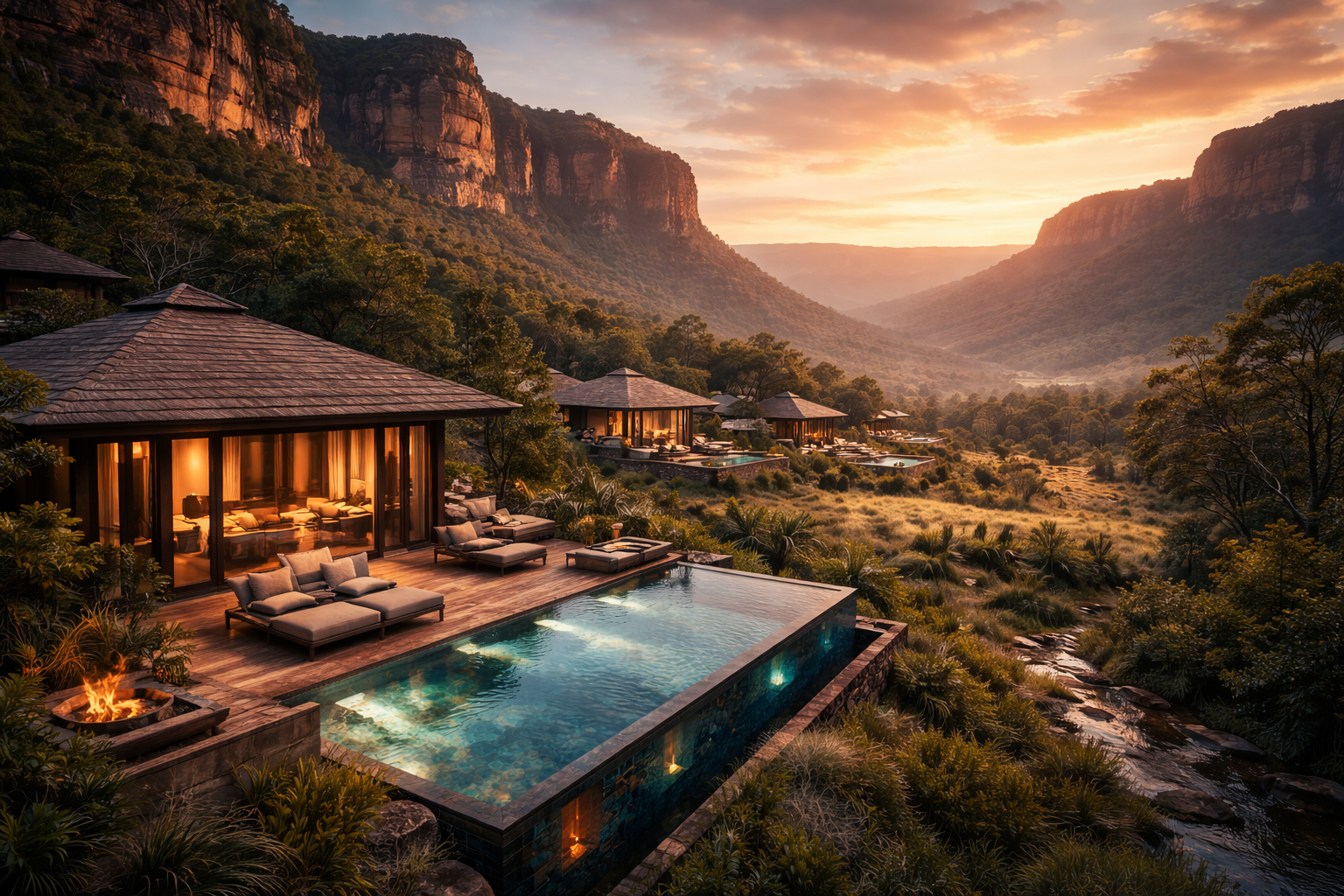
The property is anticipated to open mid-2026 with helicopter and four-wheel-drive access via Donkey Steps, replacing the closed road. There will be forty lodges with private pools, a Ritz-Carlton Spa, equestrian stables, and a naturalist programme. This makes a strong product brief.
Execution risk lies in the operational complexity. Running a 40-key property at this price, in a remote location, depends on helicopter logistics and seasonal weather patterns in the Blue Mountains.
The deeper question is whether the Ritz-Carlton Lodge brand, conceived as a North American wilderness luxury concept, can translate its equity into an Australian outback context without dilution.
The Ritz-Carlton Perth and Melbourne show the brand’s appetite for the Australian market. Wolgan Valley is a more radical test. It asks whether guests who are used to Ritz-Carlton’s marble lobbies and urban precision will trust the brand at a conservation wilderness lodge accessible only by four-wheel drive.
Emirates’ answer to that question is AU$200 million and a 19-year track record of saying yes.