

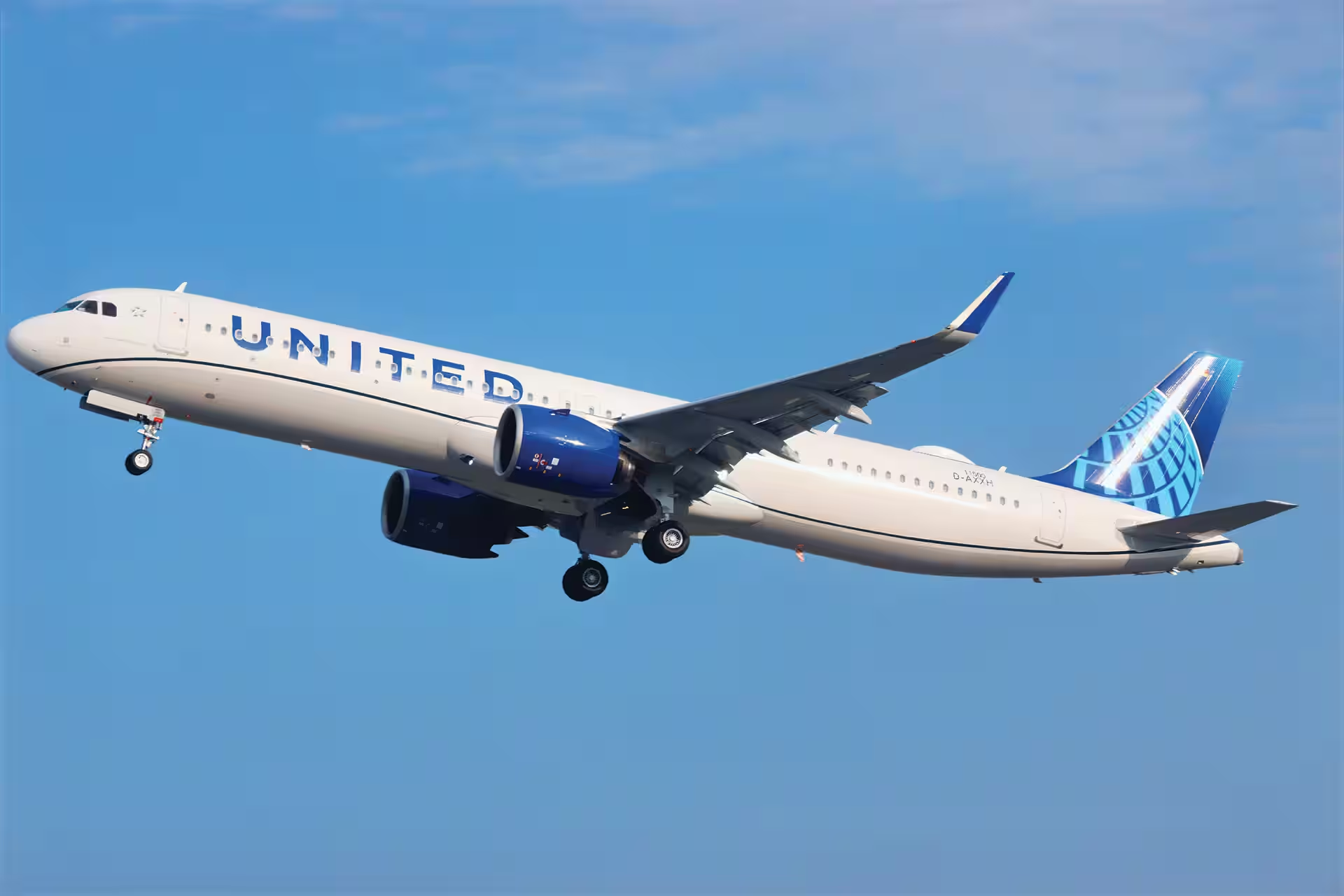
With $14.6 billion in quarterly revenue, United’s Q1 2026 results reveal an airline navigating fuel volatility with balance sheet discipline. A 5-point capacity pullback is on the horizon. United maintains a premium-first commercial strategy.
VoyageWire|April 22, 2026|ALTIMETER — Aviation Intelligence
Key Intelligence
- United Airlines reported Q1 2026 total operating revenue of $14.6 billion, up 10.6% year-over-year, the highest revenue in the carrier’s history.
- Adjusted diluted EPS came in at $1.19, up 31% year-over-year and within initial guidance of $1.00–$1.50. GAAP diluted EPS of $2.14 reflects $444 million in aircraft sale-leaseback gains.
- Fuel expense rose $340 million year over year, with the average fuel price at $2.78 per gallon, up 9.9%. United has initiated a 5-point capacity reduction versus its original 2026 plan.
- Premium revenue grew 14%, loyalty revenue 13%, and business travel revenue 14%, all outpacing the broader passenger revenue growth rate of 11%.
- United paid down $3.1 billion in debt during the quarter. Net leverage stands at 2.0x, the lowest level in years, with $17.2 billion in available liquidity.
- The carrier achieved the best on-time departure rate in Q1 among the eight largest U.S. carriers for the fourth consecutive month at the top of the group.
- Fleet expansion of 250+ new aircraft continues by April 2028, alongside the Starlink Wi-Fi rollout, targeted for full fleet coverage by the end of 2027.
Quarter in Context
The first quarter of 2026 did not arrive quietly for the U.S. airline industry. Fuel prices climbed throughout the period. This added meaningful pressure to carriers’ cost structures at a time when post-pandemic travel demand, while resilient, is settling into a more normalised pattern.
Against that backdrop, United Airlines’ Q1 results carry particular weight. The results are not merely a financial scorecard, but a signal of how the airline’s multi-year strategic investment is translating into performance under real-world conditions.
United entered 2026 with an ambitious capacity plan and a premium-first commercial architecture. This was built over several years of product investment, loyalty programme restructuring, and fleet renewal.
The $340 million increase in fuel expense from Q1 2025a 12.6% rise, tested that architecture. The quarter shows that United’s diversified revenue engine can absorb significant cost headwinds without structurally damaging margins.
Revenue Architecture
At $14.6 billion, United’s total operating revenue represents a 10.6% increase over Q1 2025, the airline’s highest-revenue first quarter on record.
Passenger revenue accounted for $13.2 billion of that figure, up 11%, with the remaining $1.4 billion split between cargo ($422 million) and other revenue ($1.02 billion).
The regional breakdown merits attention. The Atlantic corridor posted the strongest passenger revenue growth at 18.9%. This was driven by a 7.1% increase in available seat miles and a 12.6% improvement in PRASM. These indicate that capacity deployment and yield improvement are working in parallel.
The Middle East, India, and Africa segment recorded a 23.9% increase in revenue. This came on the back of a substantial 19.6% capacity expansion. United is actively building out that corridor. Latin America grew only 1.8%, with PRASM up a modest 0.9%. It was the quietest region in an otherwise strong international performance.
Total revenue per available seat mile (TRASM) rose 6.9% to 18.80 cents. Consolidated passenger load factor improved to 81.6% from 79.2%, with international load factor seeing the larger gain, up 3.5 points to 81.4%. These metrics collectively indicate that United is achieving higher yields per aircraft, not simply by selling more seats at lower prices.
Premium and Loyalty Engine
Segment-level growth matters most: premium, business, and loyalty revenue each grew ~14%. United’s model prioritises higher-yielding segments while retaining broad economy access.
The MileagePlus programme, long a cornerstone of United’s ancillary revenue strategy, received further structural enhancement during the quarter. Primary cardholders now earn up to twice as many miles per dollar on United flights compared to non-cardholders. They also receive a minimum 10% discount on award tickets and access to dedicated inventory.
These changes are consistent with a broader industry move to deepen the value proposition of co-branded credit card programmes. This revenue stream has high margins and low sensitivity to fuel price fluctuations.
The cabin segmentation strategy is also evolving. United announced the United Relax Row economy seats that can be configured as a flat surface on long-haul flights. It also introduced further differentiation across its premium and economy cabins.
The logic is clear: more granular product tiers generate new revenue vectors without the capital intensity of a full cabin redesign.
Cost Structure and Fuel Dynamics
The cost side of United’s Q1 ledger presents a more complex picture. Total operating expenses rose 8.0% to $13.6 billion. CASM (cost per available seat mile) increased 4.4% to 17.52 cents. CASM-ex, which strips out fuel, profit sharing, special charges, and third-party expenses, rose 5.9% to 13.95 cents. That latter figure is the more revealing one. It suggests underlying cost pressure beyond fuel, driven in part by a 9.8% increase in salaries and related costs and a 16.8% rise in aircraft maintenance expenses.
Fuel remains the central variable. United consumed 1.093 billion gallons in Q1 at an average price of $2.78 per gallon, up 9.9% from $2.53 a year earlier. The resulting $3.04 billion fuel bill is the single largest cost line after salaries.
Oil prices remain volatile and elevated relative to the start of the year. United’s cost management for the remainder of 2026 will depend largely on the trajectory of jet fuel.
A notable positive within the cost structure: aircraft rent surged 62% to $83 million. This is consistent with an active sale-leaseback programme that generated $444 million in gains during the quarter. These gains are real but non-recurring. They are appropriately excluded from adjusted earnings metrics.
Capacity Strategy Pivot
United’s decision to reduce planned capacity by 5 points for the remainder of 2026 represents the most consequential operational signal to emerge from this earnings release. This adjustment brings expected Q3 and Q4 capacity to flat-to-up, approximately 2% year-over-year, marking a meaningful pullback from a more expansionary posture.
The rationale is straightforward: at $2.78 per gallon, adding capacity that cannot generate sufficient incremental yield to cover its fuel cost is economically counterproductive. United will concentrate flying on routes and time periods where demand and, therefore, yield are strongest.
The goal is to protect unit revenue metrics while absorbing the elevated fuel environment. Management has indicated the airline will remain nimble. Capacity may be restored if demand conditions improve.
Long-term, the fleet expansion programme remains intact. United expects delivery of more than 250 new aircraft by April 2028, including the Airbus A321neo Coastliner, the A321XLR, the CRJ-450, and continued 787-9 Dreamliner deliveries featuring the new Elevated interior.
The 787-9 with 99 total premium seats, including 64 United Polaris seats and the new Polaris Studio product, entered service on the San Francisco-Singapore route during the quarter, demonstrating the premium-forward direction of the new fleet.
Operational Performance
United’s operational metrics for Q1 2026 are among the strongest in its recent history. The carrier achieved the best on-time departure rate among the eight largest U.S. carriers for the quarter, extending a streak that now covers four consecutive months through March, the longest such streak in United’s history.
Its per-seat cancellation rate was 44% lower than the next two largest U.S. carriers, based on available seat miles.
United carried more passengers in the first quarter than at any point in its history, and set the record for narrowbody departures scheduled in Q1 among U.S. carriers.
Digital adoption continues to accelerate: 87% of customers used digital check-in (an all-time high), and 86% used the United app on the day of travel.
The April 1 launch of TSA wait time visibility within the app attracted 1.6 million users in its first two weeks, a data point that illustrates the utility-driven engagement United is building into its customer touchpoints.
Balance Sheet and Capital Allocation
The balance sheet narrative is one of the more compelling elements of United’s Q1 story. The airline repaid $3.1 billion in debt during the quarter. If sustained, this rate of deleveraging would substantially reshape the company’s financial profile over the medium term.
Net leverage declined to 2.0x on a trailing twelve-month basis. United’s stated goal of achieving investment-grade credit ratings now appears within reach.
The return to the unsecured debt market, the first since 2019, is a meaningful signal. United raised $2 billion across two unsecured bond issuances, exceeding initial expectations.
Access to unsecured financing at scale reflects improving credit market confidence in United’s financial trajectory. Total available liquidity stands at $17.2 billion, providing a substantial buffer against further fuel price increases or demand disruption.
Operating cash flow reached $4.8 billion for the quarter, generating $2.9 billion of free cash flow. Capital expenditure totalled $1.67 billion, primarily due to aircraft deliveries. Share repurchases were minimal at $27 million, a deliberate choice that prioritises debt reduction over equity returns at this stage of the deleveraging cycle.
Product and Network Investments
United’s product investment pipeline during Q1 reflects a carrier with a clear view of where differentiation is commercially valuable. The Starlink Wi-Fi rollout, now complete on 327 dual-class United Express aircraft, is targeted for full fleet coverage by the end of 2027.
For MileagePlus members, the service will be free, adding a tangible, recurring benefit to loyalty programme membership at a time when most carriers are still charging for connectivity.
Network development during the quarter included 14 domestic routes to new destinations and expansion of the Florida schedule to its largest in United’s history. Internationally, the first Guam-based Boeing 737 MAX 8 entered service, improving the customer experience on Micronesia and intra-Asia routes with seatback entertainment, larger overhead bins, and Wi-Fi.
The JetBlue BlueSky collaboration advanced to its next phase, enabling direct booking across both carriers’ platforms, a development that modestly extends United’s effective distribution reach in markets where JetBlue holds strong positions.
A tentative agreement with the Association of Flight Attendants, if ratified, would provide 30,000 flight attendants with industry-leading wages and scheduling improvements. Labour cost certainty, particularly during a period of active fleet expansion and network growth, is strategically important for operational planning and a consistent customer experience.
VoyageWire Intelligence Take
United’s Q1 2026 results are best read not as a single-quarter performance snapshot but as a validation point for a multi-year strategic thesis. The airline has invested heavily in premium products, loyalty deepening, fleet renewal, and operational reliability. This quarter demonstrates that those investments are generating commercial returns that are structurally differentiated from commodity flying.
The capacity reduction for H2 2026 is a calibrated response to fuel economics rather than a demand signal. Revenue per available seat mile grew across all regions and major revenue categories.
The airline’s decision to constrain supply in a high-fuel environment is consistent with yield management discipline, not retreat.
The variables to watch through the remainder of 2026 are the trajectory of fuel prices, the pace of debt reduction relative to capital expenditure commitments, and whether the premium revenue growth rate sustains as corporate travel normalisation matures.
United enters Q2 with operational momentum, a strengthening balance sheet, and a fleet renewal programme that is only partially complete. The strategic direction is coherent, and the execution to date has been measurably consistent with the stated plan.
Disclaimer: This article is published for informational purposes only. The data and results referenced are sourced from public disclosures and do not constitute investment advice, financial guidance, or a recommendation to buy or sell any security.