

FORT WORTH, Texas, April 16, 2026
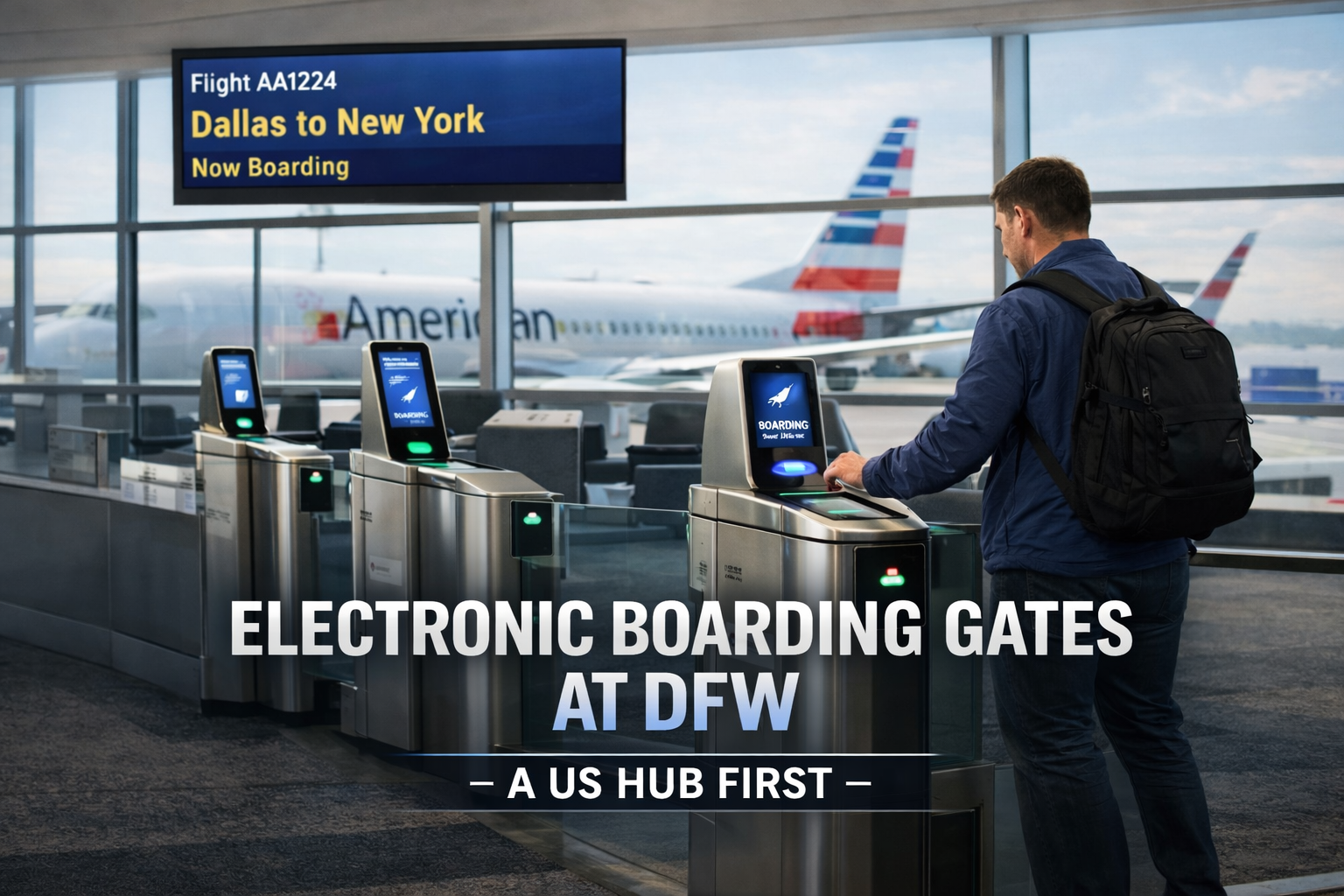
American Airlines is set to become the first major U.S. network carrier to deploy electronic boarding gates at scale at a major hub. Nearly 20 dormakaba Argus Air XS eGates are scheduled to go live at Dallas Fort Worth International Airport this summer. The rollout follows a successful pilot in November 2025.
The rollout will begin at the new Terminal C Pier Expansion before extending to the Terminal A pier, both parts of a multiyear DFW modernisation project.
The gates automatically validate boarding passes before granting jet bridge access, regulate boarding to reduce congestion, and provide branded touchscreen instructions, freeing gate agents from manual scanning so they can focus on customer-facing tasks.
“Boarding plays a key role in how customers experience the final moments before their flight,” said American’s Chief Customer Officer Heather Garboden. “This innovative change is part of a broader shift toward creating a more intuitive travel journey.”
A Swiss Vendor with a Global Footprint
The hardware suppliThe hardware supplier, dormakaba, is a Switzerland-based access solutions company. It claims to have deployed more than 7,000 eGates worldwide. Its Argus Air series is already operational at airports in Singapore, Sydney, Doha, Munich, Copenhagen, and Jeddah.
A launch of the Argus Air XS was announced at Future Travel Experience Global in September 2025. American’s DFW deal is part of a broader North American push that also includes contracts at Frankfurt Terminal 3, Munich, Düsseldorf, and Halifax Stanfield International Airport.
AA’s claim to be the “first major U.S. network carrier” warrants a close reading. The qualifier is specific: dormakaba gates, at scale, at a major hub. This does not mean U.S. airlines have not used automated boarding technology before.
Hansa has operated biometric boarding gates at U.S. airports for international departures. What AA is doing differently is deploying physical eGates as the standard boarding infrastructure across an entire hub expansion, a meaningfully higher bar.
Competitors are Taking Different Paths
America’s three largest competitors are each pursuing improvements in boarding through different means. Delta has invested heavily in ramp automation and AI-driven baggage handling, revamped its boarding zone structure in mid-2025, but has not announced physical eGate deployments.
United has focused on app-based boarding notifications and mobile pass integration, emphasising digital convenience. In contrast, Southwest completed its long-telegraphed shift to assigned seating in January 2026, opting for a structural change rather than investing in technology.
Unlike American, neither Delta, United, nor Southwest has announced a dormakaba or comparable physical eGate rollout at a major hub—highlighting the distinction and making American’s move notable in the U.S. context, even if the technology is well-established globally.
Operational Case — Promising but Unproven at this Scale
Industry data suggests automated boarding gates can cut per-passenger processing time from around 20 seconds to under 10 seconds. American’s own November 2025 pilot delivered a 25% reduction in gate-checked baggage, the only concrete operational metric the airline has disclosed publicly. No boarding time reduction figures have been released.
The broader market context supports the direction of travel. The global airport automation market, valued at $52.1 billion in 2024, is projected to reach $85.1 billion by 2033, driven by the adoption of contactless technology and biometric integration.
In the U.S., the self-boarding gates segment was valued at $1.2 billion in 2024. Projections indicate $3.5 billion by 2033 at a 12.5% CAGR.
Labour Implications Remain Unaddressed
America’s press release frames the eGates as freeing staff to focus on “exceptional customer service and operationally critical tasks,” with language carefully calibrated to avoid suggesting job loss or worker displacement.
The TWU-IAM Association, representing more than 34,000 American Airlines workers, ratified a contract extension through January 2027 in late 2024, demonstrating ongoing labour engagement despite the introduction of eGates.
No union statement on the boarding gate rollout has been made public. Industry data suggests a single automated gate can handle passenger processing that would otherwise require two to three staff members.
This figure will become more relevant as American expands the technology beyond DFW. American has confirmed plans to expand electronic boarding gates to additional hubs and gateway airports beyond DFW, with no timeline disclosed.
The DFW deployment will also serve as a showcase at Future Travel Experience Global, scheduled for Dallas in September 2026, giving AA a home-field advantage to position the rollout as an industry benchmark.
The centennial year framing is not incidental. American, which traces its roots to a 1926 air mail carrier, is leaning on the milestone to anchor a broader narrative around technological reinvention.
This now includes eGates, free AAdvantage Wi-Fi sponsored by AT&T, One Stop Security for international connections, and TSA PreCheck Touchless ID.
Whether it constitutes a genuine industry shift or a well-timed announcement will depend on the speed and scale of what follows.
VoyageWire – ALTIMETER TAKE
America’s eGate Move Is Real, But the “First” Label Is Doing Heavy Lifting.
American Airlines deserves credit for being the first U.S. carrier to commit to dormakaba eGates at hub scale, but let’s be clear: the technology has been standard at Changi, Munich, and Doha for years, and AA is not pioneering automated boarding so much as closing a gap that U.S. aviation has been embarrassingly slow to fill.
VoyageWire | ALTIMETER — Aviation Operations & Infrastructure