


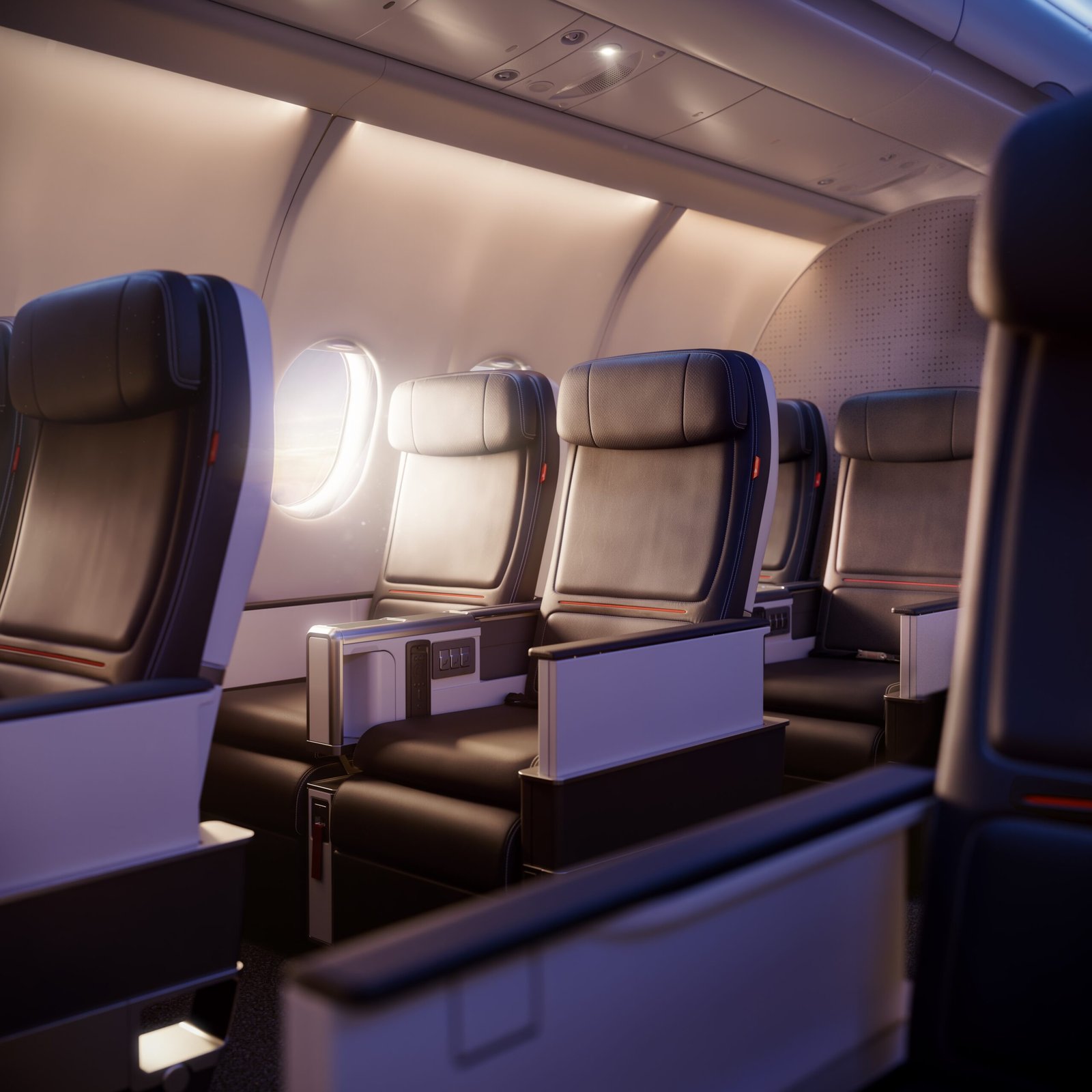
Delta Air Lines has committed over $1 billion to a two-pronged cabin overhaul — a ground-up next-generation Delta One suite for the incoming A350-1000 and, for the first time, full suite retrofits across its 42-aircraft A330-200/300 fleet.
The move extends its lead in U.S. business class suite volume but raises real questions about execution timelines, product differentiation, and whether hardware alone can close the gap with Gulf and Asian carriers.
Published: April 17, 2026|Coverage: U.S. Carriers, Premium Cabin Product, Long-Haul Strateg
1. THE TWO-TRACK FLEET STRATEGY
Delta is not deploying a single new cabin product. It is running two simultaneous programs on different airframes, with different seat architectures and different service timelines. Understanding the distinction matters for how you evaluate the strategic claim.
A350-1000 — The True Next-Gen Play
- Ground-up design: two years in development, informed by a decade of customer and crew data
- Reverse-herringbone layout with window-facing outer suites and an optional sliding window between centre pairs
- 53 Delta One suites per aircraft, a 50% premium seat mix targeting high-yield long-haul demand
- Primary markets: Asia and Africa routes, where premium yield is highest
- Deliveries begin early 2027
A330-200/300 Retrofit — Scale Play, Not Innovation Play
- 42 aircraft total: 11 A330-200s and 31 A330-300s
- Utilises the Thompson Aero Vantage XL platform with a staggered 1-2-1 architecture, rather than a bespoke design.
- Delta One suites with privacy doors will be fitted to the A330 fleet for the first time.
- Full nose-to-tail refresh; not a partial upgrade
- First retrofitted aircraft enters service in December 2026; retrofit program begins in September 2026
EDITOR’S NOTE — The A330 Retrofit Is the Bigger Operational Story
- The A350-1000 suite was expected — it’s a new aircraft and Delta would never launch a flagship without a premium product. The A330 retrofit is where the strategic intent becomes clear: Delta is willing to absorb the capex and operational disruption of retrofitting an aging widebody fleet to achieve brand consistency, not just flagship prestige.
- That is a fundamentally different decision than what United and American have made on their comparable fleets.
2. HARD PRODUCT SPECIFICATIONS
The following table summarises confirmed specifications across both cabin programs:
Feature | A350-1000 (New) | A330 Retrofit |
Seat Layout | Reverse-herringbone, 1-2-1 | Thompson Vantage XL, 1-2-1 |
Suite Privacy | Full-height sliding doors | Full-height sliding doors (first on A330) |
Bed Length | Over 6.5 feet (6″ longer than A350-900) | Comparable to current Delta One standard |
IFE Screen | 24-inch 4K QLED | 24-inch 4K QLED |
Cushioning | Memory foam + pillow-top layer | Memory foam + pillow-top layer |
Connectivity | Bluetooth, USB-C, wireless charging, AC | Bluetooth, USB-C, wireless charging, AC |
New Features | Sliding window between center pairs, shoe cubbies | Self-serve snack station at cabin entry |
Accessibility | Tactile controls, accessible lavatories | Tactile controls, accessible lavatories |
All other cabins, Premium Select (Delta’s premium economy class), Comfort+ (extra-legroom economy), and Main (regular economy) also receive memory foam seating, 1 inch of additional legroom (achieved by making seat backs thinner), and seatback shelf additions. Screen upgrades extend across the fleet: 16-inch ultra-high-definition (4K) screens in Premium Select, 13-inch 4K screens in economy.
3.FACT-CHECKING THE ‘MOST SUITES’ CLAIM
Delta’s announcement states it will hold ‘the most business class suites of any U.S. airline.’ This claim deserves three-part scrutiny before being repeated as fact.
The Definition Problem
Delta defines a suite as a business class seat with a sliding privacy door. United’s Polaris and American’s Flagship Suite products are also deploying doors across their widebody fleets.
The ‘lead’ Delta claims are quantitative leads in door-equipped seats; they are not claims about seat width, service quality, or experiential differentiation.n.
The Volume vs. Quality Distinction
Delta’s suite count lead is partly a function of the A330 retrofit decision. United has focused its Polaris suite rollout on newer 787 and 777 variants; American is concentrated on 777-300ERs.
Delta’s willingness to retrofit older A330 airframes increases its absolute suite count but introduces an engineering consideration worth noting: adding enclosed suites to ageing A330 airframes adds weight, which can affect fuel burn and potentially necessitate trade-offs in rear cabin configuration to maintain passenger count targets.
The 25-Point Satisfaction Claim
Delta cites a ’25-point satisfaction gain’ attributable to these upgrades. This metric, as published, is unverifiable: it does not specify the survey instrument, the baseline period, the sample size, or the comparison group. Treat it as directional marketing data, not independent performance evidence.
CRITICAL CONTEXT: What the ‘Most Suites’ Claim Does Not Cover
- Seat width: The A350-1000 Delta One suite is approximately 21-22 inches wide. Qatar Airways’ QSuite reaches 21.5 inches and Singapore Airlines’ New First Class exceeds 28 inches — though these are different cabin classes.
- Service quality: Gulf and Asian carriers continue to lead on soft product — crew ratios, culinary investment, and amenity depth. A 24-inch screen does not close that gap.
- Network alignment: Suite volume only generates yield if the routes served have sufficient premium demand. Delta’s Asia/Africa focus on the A350-1000 is the right strategic alignment; the A330 routes need separate evaluation
STRATEGIC READING: WHAT DELTA IS ACTUALLY DOING
Scale Is the Real Moat
The most strategically significant element of this announcement is not the seat design. It is Delta’s stated target of 800+ aircraft with modern interiors in five years, with 90% of Delta One seats being suites by 2030. Any carrier can commission a compelling flagship suite. Very few can deploy product consistency at that scale.
United and American launch flagship products on select aircraft. Delta is engineering a predictable experience across its full widebody fleet. For corporate travel buyers whose procurement decisions increasingly factor in product consistency, not just route coverage, this is a material competitive variable.
Yield Architecture, Not Luxury Positioning
The 50% premium seat mix on the A350-1000 is not a luxury statement. It is a yield optimisation decision. Delta is allocating more aircraft to higher-margin seats on routes to Asia and Africa, where premium demand is structurally strong, and price elasticity is lower. This is a revenue management decision expressed in hardware.
Framing this as Delta ‘chasing’ Emirates or Singapore Airlines misreads the strategy. Delta is not building a prestige brand product. It is building a high-yield premium product at an industrial scale. These are distinct objectives requiring distinct evaluative frameworks.
The Snack Station as an Operational Signal
The always-open self-serve snack station introduced on the A330 refresh allows passengers to help themselves to snacks at any time without waiting for flight attendant service. This reduces the crew’s workload during long flights and aligns with passenger preferences for greater control and convenience in premium cabins, a feature other international airlines have used for years.
Although Delta is introducing this feature later, implementing it across many aircraft helps close the gap with competitors.
5.DEPLOYMENT TIMELINE
Milestone | Timeline | Detail |
Sep 2026 | A330 Retrofit Launch | First aircraft enters service; Thompson Vantage XL suites debut on A330 fleet |
Dec 2026 | A330 First Service | First fully retrofitted A330 in revenue service |
Early 2027 | A350-1000 Deliveries | New flagship begins deliveries; next-gen Delta One suite launches |
2030 | 90% Suite Target | 90% of Delta One seats across fleet to be full suites |
2031 | 800+ Aircraft | Full modern interior rollout across narrowbody and widebody fleet |
6.COMPETITIVE LANDSCAPE SNAPSHOT
The U.S. carrier premium cabin race is now explicitly a three-way contest on suite volume and product quality. The competitive positions as of April 2026:
Delta Air Lines
- Suite led by volume (post-A330 retrofit); most consistent fleet-wide deployment plan
- Next-gen A350-1000 product is genuinely differentiated in the U.S. market.
- Weakness: soft product investment still trails Gulf carriers
United Airlines
- Polaris suite rollout concentrated on newer 787/777 variants; cleaner airframe fit
- Stronger Transatlantic network alignment vs. Delta’s Asia focus
- Weakness: slower fleet-wide consistency; lower suite count in absolute terms
American Airlines
- Flagship Suite on 777-300ER is the most premium hard product of the three domestically.
- 5-inch screen, smaller than Delta/United but better proportioned per seat-width ratios
- Weakness: fleet-wide rollout is the slowest; network premium yield recovery is still lagging
WHAT TO WATCH
|